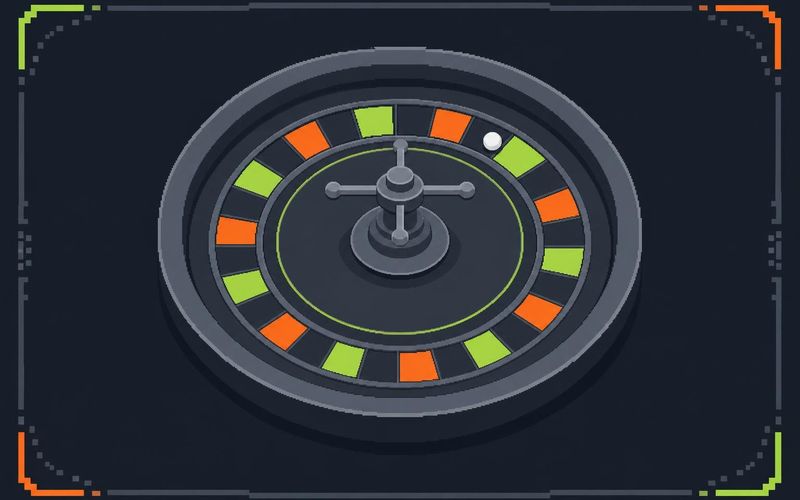
A European wheel has 37 pockets: the numbers 1 to 36, half red and half black, plus a single green zero. Every payout on the layout is calculated as if that zero did not exist. A straight-up bet on one number pays 35 to 1, yet the true odds against it are 36 to 1, and that one-pocket gap is the entire business model of roulette. Bitcoin roulette changes nothing about this arithmetic, and that is the first thing to grasp about how bitcoin roulette works. It changes the currency, the minimum stake and, on provably fair tables, who is able to check the result.
Roulette rules: the bets on the layout
The layout splits into inside bets, placed on the numbers themselves, and outside bets, placed on the boxes around them. The payouts below are the same at a land-based table and in a bitcoin casino.
| Bet | Covers | Pays | Win chance (single zero) |
|---|---|---|---|
| Straight up | 1 number | 35 to 1 | 2.70% |
| Split | 2 numbers | 17 to 1 | 5.41% |
| Street | 3 numbers | 11 to 1 | 8.11% |
| Corner | 4 numbers | 8 to 1 | 10.81% |
| Six line | 6 numbers | 5 to 1 | 16.22% |
| Dozen or column | 12 numbers | 2 to 1 | 32.43% |
| Red/black, odd/even, 1–18/19–36 | 18 numbers | 1 to 1 | 48.65% |
Notice that the zero is never part of an outside bet. When the ball drops into it, every red/black, odd/even and high/low wager loses on a standard European table.
What are the bitcoin roulette odds and the house edge?
The house edge is the share of each stake the game keeps over the long run. On a single-zero wheel it is 1/37, or 2.70%, and it is the same on every bet listed above, as the Wizard of Odds roulette analysis also shows. A player who stakes 0.01 BTC per spin for 100 spins can expect to lose about 0.027 BTC on average, whether those spins went on single numbers or on red.
What differs between bets is the variance. A straight-up bet wins rarely and pays a lot; an even-money bet wins almost half the time and pays little. Over a short session that difference matters enormously. Over thousands of spins it disappears into the same 2.70%.
- 2.70%
- European single zero, every bet
- 5.26%
- American double zero, most bets
- 7.89%
- American five-number bet
- 1.35%
- French La Partage, even-money bets
Wheel variants: European, American, French and mini
The variants differ only in their zero pockets and in two rules for even-money bets.
European roulette
Thirty-seven pockets and the 2.70% edge described above. Most bitcoin casinos list this version first, and it is the sensible default when no French table is offered.
American roulette
The American wheel adds a second green pocket, the double zero, which pushes the edge to 2/38, or 5.26%. It also introduces the five-number bet on 0, 00, 1, 2 and 3, which pays 6 to 1 and carries an edge of 7.89%, the worst bet on any standard roulette table. There is no rule-based reason to choose the double-zero wheel when a single-zero one sits in the same lobby.
French roulette
French roulette uses the single-zero wheel and adds one of two rules for even-money bets. Under La Partage, half of the stake is returned when the ball lands on zero. Under En Prison, the stake stays on the table for one more spin and is released if that spin wins. Either way, the edge on those bets falls to roughly 1.35%. The layout often carries French labels such as rouge, noir, pair and impair, which can be the only visible sign that the better rule applies.
Mini roulette and automated wheels
Of all the variants, this one costs the most per spin. Mini roulette runs on 13 pockets, numbers 1 to 12 plus zero. A straight-up bet pays 11 to 1 against true odds of 12 to 1, so the edge is 1/13, or about 7.69%. Automated “auto roulette” tables with a physical wheel and no dealer use the normal European rules and simply spin faster, which means more bets per hour and therefore more expected loss per hour at the same stake.
What bitcoin adds to the table
Three things separate a crypto roulette table from a conventional online one, and they explain how bitcoin roulette works in practice once the wheel itself is understood.
Stake size. Bitcoin divides into satoshi, so tables can accept stakes worth a fraction of a cent. That makes it cheap to learn the layout with real outcomes, and it also makes it easy to lose track of value when balances are shown in mBTC or satoshi rather than dollars.
Settlement. Deposits and withdrawals move on the blockchain. A bitcoin transfer is usually considered settled after one to six confirmations, at roughly ten minutes per block, plus any review time the casino adds before releasing a withdrawal.
Verification. On provably fair games, the casino commits to a secret server seed by publishing its SHA-256 hash before the round. The result is generated from that seed, a client seed you can change, and a counter called the nonce. After the seed is revealed, any spin can be recomputed and the number compared with what the wheel showed. A live-dealer table with a real wheel and a camera cannot work this way; its fairness rests on the studio and the licence, as in any casino.
What do players get wrong about roulette?
- A number that has not appeared for 100 spins is not "due". Each spin is independent, and the chance of any single number stays at 1 in 37.
- Covering most of the layout does not create an edge. It trades many small wins for occasional larger losses, at the same 2.70%.
- A provably fair badge proves the result was not altered after the bet. It says nothing about the payout table, which still contains the house edge.
The Martingale deserves its own sentence, because it is the system most often recommended in crypto forums: doubling after each loss on red needs only ten consecutive losses to turn a 1-unit opening bet into a 1,024-unit stake, and runs of ten non-reds come up far more often across a long session than intuition suggests.
For the rules of the card games that share the same lobby, the bitcoin blackjack and bitcoin baccarat pages cover the decisions and edges in the same format. How seeds and hashes work in general is explained on the bitcoin casinos page.
Questions and answers
Is bitcoin roulette rigged?
A provably fair roulette game can be checked spin by spin: the casino publishes a hash of its server seed before you bet, and after the round you can recompute the result from the revealed seed, your client seed and the nonce. A game without that mechanism has to be trusted the same way any online casino game is trusted, through its licence and its testing lab.
Which roulette wheel has the best odds?
French roulette with the La Partage rule, because half of an even-money stake comes back when the ball lands on zero. That brings the house edge on red/black, odd/even and high/low down to 1.35%. On every other bet, French and European wheels both sit at 2.70%.
Can a betting system beat roulette?
No. Every bet on a given wheel carries the same expected loss per unit staked, and no sequence of bets changes that number. Progressions such as the Martingale only rearrange when the losses arrive, and the table maximum stops the doubling long before it can recover a long losing run.
What is the smallest bet in bitcoin roulette?
Crypto tables often accept stakes far below a cent, sometimes down to a handful of satoshi (one satoshi is 0.00000001 BTC). The minimum is set by each game, so the table limits shown before the first spin are the figure to check.